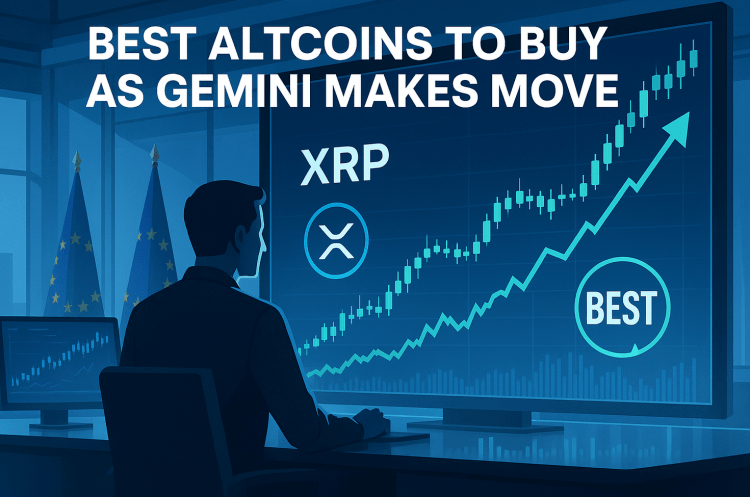
Gemini’s XRP Perps Go Live In EU — Why ‘Top Altcoins’ Like $BEST Are In Play
What to Know: Gemini launches XRP perpetuals for EU traders, offering up to 100x leverage and SDC settlement on a regulated venue. The move expands derivatives liquidity and price discovery for XRP, likely tightening spreads and attracting market makers across pairs. Increased hedging and funding strategies can accelerate alt rotations, boosting on-chain activity across wallets, bridges, and DEX aggregators. As EU XRP perps spur altcoin rotations, Best Wallet Token’s $16. 8M presale is a smart purchase now. Gemini just switched on XRP perpetual contracts for EU customers, letting traders go long or short with up to 100x leverage and no monthly expiry. Perps settle in SDC and live inside Gemini’s regulated EU derivatives stack, and this combo offers access to XRP volatility while keeping operations under an institutional-style framework. The launch adds a fresh venue for XRP price discovery and funding-rate strategies, which tends to attract market makers and bring tighter spreads. Why is this important? Because it adds more derivatives liquidity to one of the largest crypto payment assets and pulls capital into alt rotations. As a result, RP has now recovered to above $2. 3 in the last day (+3. 49%), alongside many of the best altcoins on the market, including Ethereum (1. 15%), Solana (+1. 33%), and BNB (+0. 14%). When a Tier-1 venue lights up a new perp, traders often start hunting catalysts across the rest of the board. And it’s often wallet infrastructure that sees the upside because that’s where users bridge, swap, and stake while moving between trades. That’s the setup that can funnel attention toward top altcoin with direct utility. Enter Best Wallet Token (EST) and Best Wallet, a non-custodial, multi-chain wallet with an integrated DEX aggregator, a curated ‘Upcoming Tokens’ presale hub, and a planned debit card. EST owners get fee reductions, governance, staking boosts, and access to some of the best crypto presales on the market. If XRP perps kick off risk-on rotations, a wallet token that monetizes swaps and presale activity is a clean way to play the flow without guessing single-coin winners. More perp venues usually equal more trading cycles, more bridging, and more on-chain execution. Wallets that compress those steps into one interface capture value at the ‘picks and shovels’ layer, and Best Wallet (alongside ES) is designed to sit exactly there. ➡️ To learn more about Best Wallet Token, read our guide. Best Wallet Token (EST) Multi-Chain Wallet With Built-In Presale Access Best Wallet is a non-custodial app built for daily use, not cold storage. It supports six major chains (Solana and Ethereum among them), routes same-chain and cross-chain swaps through an integrated DEX aggregator, and offers vetted ‘Upcoming Tokens’ so you can join early presales from inside the wallet. It also offers multi-wallet asset management, buying and selling within the wallet, on-ramp services, and a continuously-evolving DeFi ecosystem. Best Wallet Token (EST) ties it all together with trading fee reductions, governance rights, and boosted staking rewards (a staking aggregator is in the works as we speak). The roadmap shows a browser extension, NFT gallery, richer portfolio views, and a debit card to spend crypto are coming in the future. That mix turns EST into a utility token linked to swaps, discovery, and payments. So, when derivatives activity sends users rotating between majors and alts, EST’s unified flow helps capture those transactions at the point of execution as the mechanism that returns value to holders. EST’s presale has raised over $16. 8M, with a token price of $0. 025905, with the total raise at $16. 85M. The token’s got substantial potential come next year our EST price prediction shows a potential price point of $0. 05106175 by the end of 2026 (a 97% increase from today’s price). That’s not the only way to gain from this presale, though. You can stake your EST tokens immediately after purchase for a dynamic 78% APY (it will drop as more users stake). ➡️ Here’s how to buy EST right now. All in all, Gemini’s move signals bullish times for altcoin rotations, and traders are already making moves. And Best Wallet Token can be one of the smartest investments in this period, especially if price predictions come true. Join the EST presale before it ends in 22 days. Authored by Elena Bistreanu, NewsBTC Disclaimer: This is informational only. Presales and derivatives carry high risk. Verify contract addresses, read official docs, and never invest more than you can afford to lose.