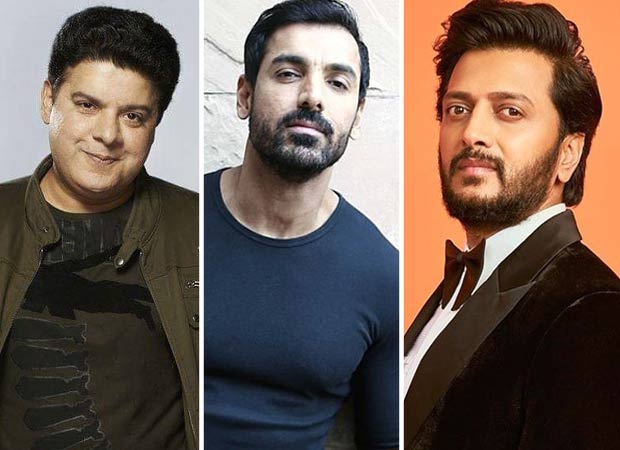
A public notice published on November 7, 2025, in Komal Nahta’s Film Information has confirmed that Jai Ho Media LLP has officially acquired the exclusive, perpetual, and worldwide rights to the upcoming Hindi film 100%, starring John Abraham, Riteish Deshmukh, and others. The film is directed by Sajid Khan and written by Aakash Kaushik, Madhur Sharma, and Rohan Shankar. The acquisition covers an extensive range of rights, making Jai Ho Media LLP the sole owner of the film’s global intellectual property. According to the notice issued through ANM Global Inc., Advocates & Solicitors, the deal grants Jai Ho Media LLP ownership over all Intellectual Property Rights and underlying works related to the film. This includes the right to make sequels, remakes, spin-offs, or any other derivative projects based on the film. The notice also specifies the inclusion of Linear Broadcast Rights (covering TV, satellite, cable, DTH, IPTV, and other transmission mediums) and Non-Linear Video-on-Demand Rights (such as AVOD, SVOD, TVOD, and digital streaming formats). Beyond screen exhibition, the company now holds transport and commercial rights for air, ship, railways, and hotels, as well as music, dubbing, and subtitling rights across all global languages. It also covers syndication, background scores, lyrics, and ancillary or residual rights that may arise through any future technological formats or platforms, essentially securing complete control over every possible mode of distribution and exploitation worldwide. The notice further invites any person or entity claiming ownership or rights to the film to come forward with documented proof within 15 days of publication. After this stipulated period, no claims will be entertained, ensuring that Jai Ho Media LLP proceeds with an unchallenged title over the film’s rights. With this acquisition, Jai Ho Media LLP now fully controls the commercial, creative, and digital exploitation of 100% “throughout the territory of the whole world, universe, [and] planets including India,” as humorously worded in the notice. The formal declaration reinforces the studio’s legal position ahead of the film’s release and eliminates any potential disputes surrounding ownership or revenue sharing. Interestingly, 100% was formally announced on August 29, 2022, and was planned for a Diwali 2023 release. This was a time when 100% was to star John Abraham, Riteish Deshmukh, Nora Fatehi and Shehnaaz Gill. As pe the 2022 announcement video, the comic caper was to be produced by Bhushan Kumar and Krishan Kumar of T-Series and Amar Butala of GBA Media. Amar Butala also owns Jai Ho Media LLP and hence, he has taken over the film as the sole producer. In the past, Amar Butala has produced Sidharth Malhotra-Rashmika Mandanna starrer Mission Majnu (2023) and also served as the co-producer of Bajrangi Bhaijaan (2015), Hero (2015), Tubelight (2017), Love Sonia (2018), Total Dhamaal (2019), Kesari (2019) and Mission Mangal (2019). He was also set to produce a film named Bull, based on Operation Cactus of 1988. However, the Shahid Kapoor-starrer was shelved. The public notice mentions that 100%’s ‘current star cast’ comprises John Abraham, Riteish Deshmukh and others. It now remains to be seen whether 100% will proceed with the same cast or undergo changes before it goes on floors. The project’s next steps, including its revised production timeline, are expected to be announced soon. When contacted by Bollywood Hungama, both Amar Butala and Sajid Khan were unavailable for commentAlso Read: Sajid Khan set to launch Govinda’s son Yashvardhan Ahuja with his directorial comeback after 7 years.