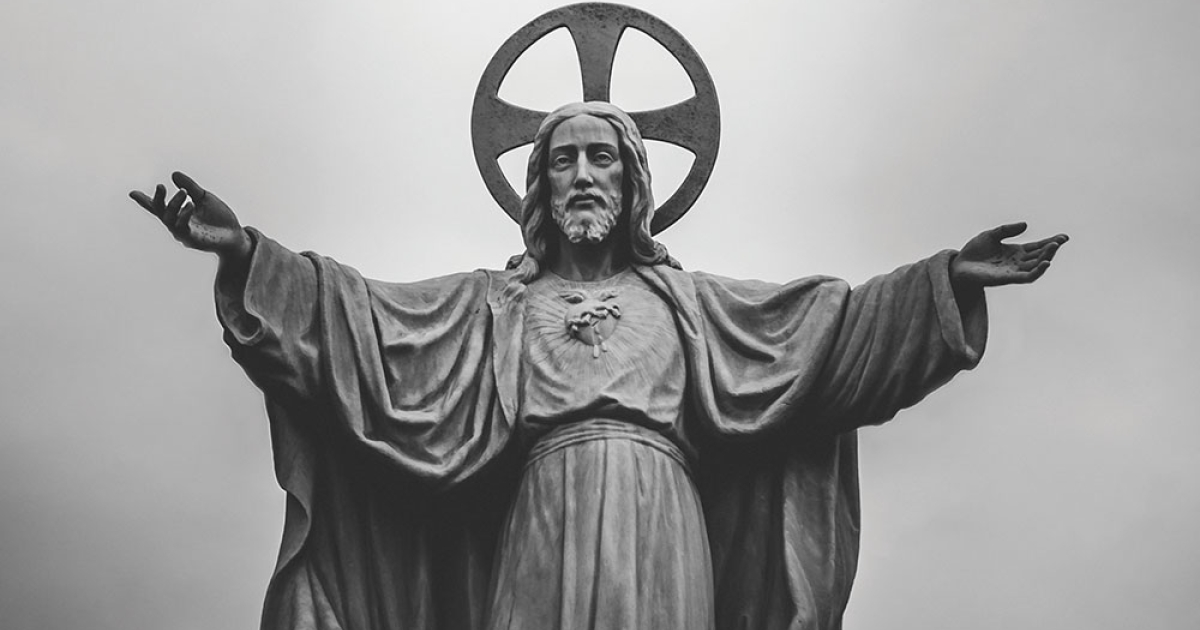
The halo (from the Greek *halos*, meaning ring or disc) is a natural phenomenon seen as a ring around the sun or moon, created by refracted or reflected light. Similarly, the corona (Latin for wreath) appears surrounding the sun during a total eclipse. Any of these halo forms may be called a *nimbus* (Latin for cloud). Some authorities suggest these terms can be used interchangeably along with *aura*, *aureole*, *glory*, or *gloriole* (Latin for a small glory).
### Origins and Early Use of the Halo
The halo was not a Christian artistic invention. Depictions of a burst of light behind revered persons and deities began in the East at least two centuries before Christ. This practice spread to Rome, where rays of glory radiated from Helios, the sun god.
Due to their association with paganism, Christian artists were initially slow to adopt halos. However, the concept of martyrs crowned in glory aligns with the promise in Revelation:
> “Remain faithful until death, and I will give you the crown of life” (Revelation 2:10).
Rays of light emanating from the figure of Jesus first appeared in Rome in the mid-third century. Signs of glory were initially reserved for Jesus alone until the fifth century, when artists began to use halos to indicate sainted individuals. Over time, special radiances took different shapes depending on the holiness or eminence of the subject.
### Halos in Christian Iconography
Christian iconographers placed halos around the heads of Jesus, God the Father, the Holy Spirit dove, the Virgin Mary, angels, and recognized saints.
– **The Nimbus:** A ring (simple circle), a disk (solid circle), or a corona (luminous circle) may all be termed a *nimbus*. In art, these forms appear behind or surrounding the heads of the blessed. They may also be shown horizontally, hovering over holy heads, or tilted over the crown of the head to reflect the perspective of the sanctified figure.
– **The Mandorla:** The *mandorla* (Italian for almond) first appeared in the fifth century and refers to a supernal, ovoid shape outlining the entire body of an individual. Also known as the *vesica piscis* (a stylized fish shape), it came to signify the divinity of the Persons of the Holy Trinity. Depicting the Virgin Mary or other saints inside a mandorla is typically reserved for when they hold the Christ Child or are in the company of the divine Son of God. The mandorla’s use declined in the 15th century as it became “incongruous in a naturalistic context,” replaced by the aura or glory.
– **The Aureole and Gloriole:** The *aureole* (Latin for golden) is a radiant light surrounding the head or emanating from the body of a sacred figure. The *gloriole* (“a small glory”) usually refers to a crown of glory, likely blending the Latin words *gloria* and *aureole*.
### Special Halo Forms and Their Meanings
– **The Triangular Halo:** This halo signifies the doctrine of the Holy Trinity—one God in three Divine Persons. It is most often seen behind the head of God the Father and, less commonly, God the Son or the Holy Spirit. This halo is never used for mortals, regardless of holiness.
– **The Tri-Radiant Halo:** Also called the cruciform halo, it is an ancient symbol often shown within a disk behind the head of Jesus Christ. The three bars or rays imply his divinity and may reference the cross—sometimes a hidden fourth bar is included, obscured by Christ’s head and neck. Since all three Divine Persons share equal dignity, the tri-radiant halo may also be used for the Father and Holy Spirit.
– **The 12-Starred Crown:** This halo takes the form of a crown of twelve stars and is reserved for Mary as the “woman of the apocalypse”:
> “A great sign appeared in the sky, a woman clothed with the sun, with the moon under her feet, and on her head a crown of twelve stars” (Revelation 12:1).
Pope Benedict XVI explained that this symbol represents the twelve tribes of Israel and signifies that the Virgin Mary is at the center of the People of God and the entire communion of saints. It also depicts Mary as queen of the apostles.
– **The Hexagon:** Seen in late Middle Ages art behind figures representing virtues, the hexagonal halo is more often associated with holy personages of the Old Testament, including those who lived during the New Testament era but before the Resurrection, such as Saints Joachim and Anne or Joseph.
– **The Square:** A short-lived halo form, the square does not signify sanctity but rather a person of high station or an artist’s living patron at the time the artwork was created.
– **The Scroll:** Rarely seen, this halo depicts a piece of parchment scrolling behind a person’s head, indicating the addition of their name to the canon of saints. This imagery is the origin of the word “canonization.”
### Biblical Foundations
The names and symbols of God have deep biblical roots. In Exodus, God reveals to Moses that his name is YHWH (יהוה), meaning “I am who I am” (Exodus 3:14). The Septuagint translates this Hebrew term into Greek as *ho on*, and in Latin as *ego eimi*. Christ used this name for himself, saying:
> “Before Abraham came to be, I AM” (John 8:58).
### Walking in Holiness
Through a living belief in our Lord and by following the examples of our holy forebears, let us walk in good works (see Ephesians 2:10) so that we may all receive the halos God has prepared for us.
—
*This exploration of halos and their rich symbolism reveals the layers of meaning embedded within Christian art and tradition, connecting natural phenomena, ancient practices, and profound theological truths.*
https://themiscellany.org/halos-many-signs-sanctity