Follow ZDNET: Add us as a preferred source on Google.
—
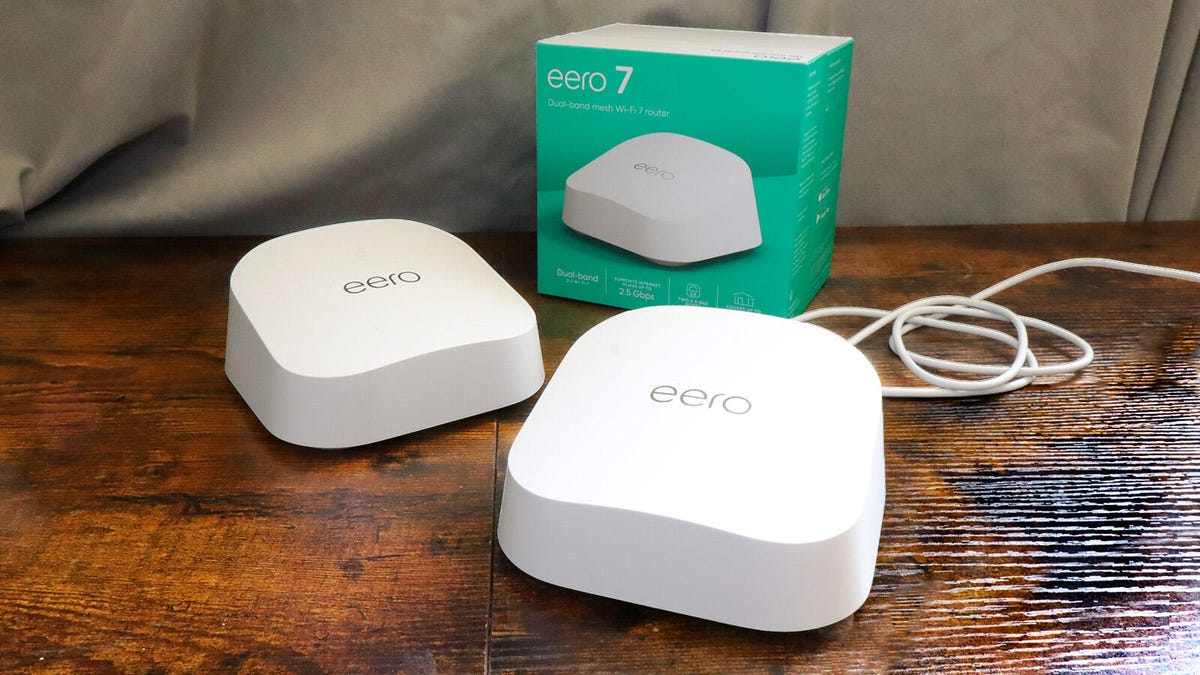
One of the biggest hurdles of any new technology is getting people to adopt it. In my opinion, the best way to see widespread adoption is to make onboarding really easy — eliminate that high barrier of entry. A device that exemplifies this ideal is the new **Eero 7 Dual-Band Mesh Wi-Fi 7 Router**.
*Also: [Should you upgrade your traditional Wi-Fi router to mesh? I compared the two, and here’s my take](#)*
—
### Introducing the Eero 7 Dual-Band Mesh Wi-Fi 7 Router
In late February, Eero announced this device as an entry-level router designed to bring Wi-Fi 7 into homes. The Wi-Fi 7 standard promises lower latency, higher wireless speeds, and increased bandwidth to support multiple devices. These features are all present in the Eero 7, enabling users to enjoy the next generation of connectivity.
—
### Setting up the Eero 7
Before diving into my experience with the Eero 7, let me briefly explain what this device is for those unfamiliar. It is a compact dual-band router that supports both 2.4 GHz and 5 GHz channels, delivering **wireless speeds of up to 1.8 Gbps and wired speeds of up to 2.3 Gbps**, according to Eero.
On the back, you’ll find two 2.5 GbE Ethernet ports, with a USB-C input for the power adapter positioned between them.
*Also: [The right way to run an internet speed test (and how I use the results for better Wi-Fi)](#)*
—
### A Comparison: Eero 7 vs. Asus RT-BE86U
I had two review units of the Eero 7, and the more time I spent with them, the more I compared them to the Asus RT-BE86U router I recently tested. My experiences with these two products couldn’t have been more different—in fact, I had a better time with the Eero 7.
Setting up the Eero 7 was incredibly easy. I started by downloading the official Eero app on my phone, as per the instructions. Then, I unplugged my modem, connected it to the router, and plugged both into the wall socket. I opened the app, followed the on-screen instructions, and within five minutes, I had a wireless connection established.
The whole process was so quick that I double-checked just to make sure I hadn’t missed a step. But I hadn’t—it really was that fast.
Connecting a second Eero 7 router as an extender was an even simpler process: I only had to plug in the power adapter and use the app to link it to the original device. No fuss, no additional software patches—everything worked right out of the box.
—
### Impressive Speeds and Coverage
Eero states that a single Eero 7 can cover up to 2,000 square feet and support over 120 devices. I live in a perfect testing environment to evaluate this, and the router delivered fast Wi-Fi 7 speeds throughout my apartment—even reaching my kitchen, which is typically a Wi-Fi dead zone.
The signal was strong and stable, even with multiple smartphones, computers, and TVs connected simultaneously. Everything ran smoothly without any hiccups.
The Eero app includes an internet speed test, and according to the results I observed, the router provided **download speeds up to 690 Mbps and upload speeds up to 24 Mbps**. A note in the app explains that these speeds support streaming 4K movies, video calls, and online gaming all at once.
Third-party internet speed tests reflected slightly different numbers: download speeds typically around 200 Mbps and upload speeds near 20 Mbps. Don’t be discouraged by these discrepancies — these figures are still more than enough for most users.
*Also: [Slow Wi-Fi at home? 3 things I always check first for faster internet speed](#)*
—
### Build Quality and Missing Features
While I enjoyed using the Eero 7, it does lack some features that others might find important. For example, although you can create guest networks and set screen time schedules, the router does **not** include parental controls or built-in internet security.
To access these features, users will need to subscribe to Eero Secure. The subscription costs $10 per month or $100 per year.
Power users might also be disappointed by the absence of a third 6 GHz channel. This could cause wireless speeds to be slower or inconsistent compared to tri-band routers. During my testing, there were a few moments when web pages would endlessly load, requiring a manual refresh.
*Also: [Starlink just unveiled a $40/month unlimited data plan but there are a few catches](#)*
—
### Final Thoughts
Despite its limited feature set, I didn’t mind the Eero 7’s simplicity. The straightforward installation process and solid connection speeds made the experience very enjoyable.
At the bottom of the Eero 7’s box is the product’s tagline: **“The way Wi-Fi should be.”** I have to agree—this little gadget sets a new standard for Wi-Fi in 2025.
If you’re looking to upgrade your at-home network, the Eero 7 router is a must-have.
—
*ZDNET’s buying advice:*
The Eero 7 offers an easy setup, reliable coverage, and impressive speeds, making it ideal for most home users who want the latest Wi-Fi 7 technology without complicated configuration. Just keep in mind its subscription-based advanced features and potential speed limitations for power users.
https://www.zdnet.com/article/if-youre-thinking-of-upgrading-to-wi-fi-7-the-mesh-system-i-recommend-is-now-21-off/